UdyamGita

The Gita Blueprint for Leading and Winning in Business

UdyamGita

Akṣhara Parabrahma Yoga

Chapter 8 - Verse 3,4
श्रीभगवानुवाच |
अक्षरं ब्रह्म परमं स्वभावोऽध्यात्ममुच्यते |
भूतभावोद्भवकरो विसर्ग: कर्मसञ्ज्ञित: || 3||
अधिभूतं क्षरो भाव: पुरुषश्चाधिदैवतम् |
अधियज्ञोऽहमेवात्र देहे देहभृतां वर || 4||

Translation

The Lord said: Brahma refers to the imperishable Lord who pervades
everything and everyone. Adhyatma refers to the material equipment that
allows a soul to act (body, sense organs, conscience). Karma refers to the
Lord’s act of creation, which is responsible for the birth and existence of all
living beings.

O Arjuna! The five basic elements of material nature (earth, fire,
water, space, and wind) form Adhibhoota. Superior deities who reside
inside and govern the physical bodies of living beings (namely Sesha, the
serpent deity, and the four faced deity Brahma) form Adhidaiva. Powering
all living beings and the consumer of offerings in all sacrifices is I, going
by the name of Adhiyajna (Lord of Sacrifice).

Unfiltered First Take

One has to have a clear organizational structure to operate without friction and with the right ownership. Everyone in the organization should know what qualities and tasks are non negotiable. They should clearly understand their individual responsibilities, tasks, and ownership. They should also know how much free will they have to operate according to their own judgment. Complete awareness of resources, their availability, the process of using them, the way of working that is appreciated in the organization, and the outcomes of their actions or inactions should be very clear and documented wherever applicable.

Even though the entrepreneur provides clear processes, implementation details, and implications of actions, he should understand that markets and situations are always changing. Therefore, enough room and flexibility should be given to operate with individual judgment. While empowering the team, the entrepreneur should also plan to mitigate risks when such situations arise. For this, the right leaders should be placed in positions to oversee execution, deviations, corrective actions, and implications.

Entrepreneurs should motivate every employee in such a way that they can relate to the entrepreneur within themselves and act as if they are working on direct one to one instructions from the founder. When this state is attained, no one needs to intervene, interfere, or correct. The organization then runs like a well oiled clock. One important point highlighted here is that the entrepreneur is the one who has to make the maximum sacrifices, and that is why he is called a true leader and a differentiator.

UdyamGita Interpretation

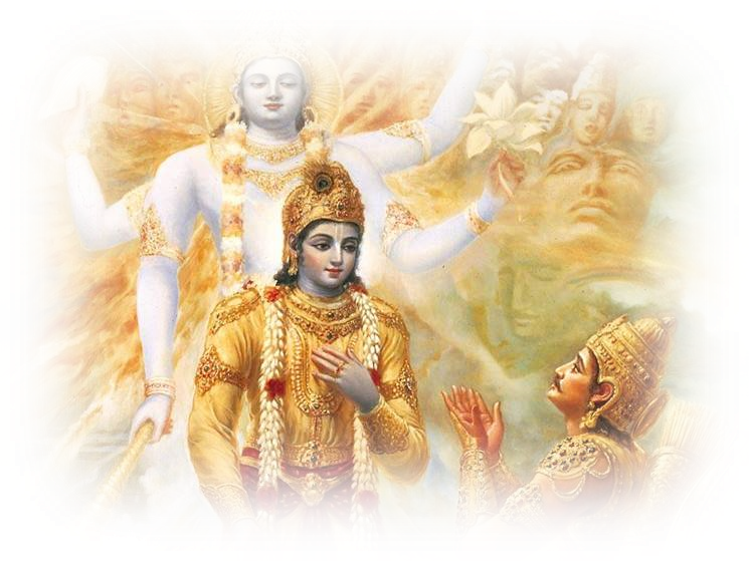
Krishna responds to Arjuna’s questions with precision. He does not speak in abstractions—he defines roles.

Brahman is the unchanging ultimate reality. Adhyatma is one’s own nature. Karma is purposeful action that drives creation forward. Adhibhuta is the constantly changing material world. Adhidaiva is the governing intelligence behind systems. And finally, Krishna declares something striking: He Himself is Adhiyajna—the indwelling force that makes all action meaningful.

In essence, Krishna maps the entire operating system of life—what is permanent, what changes, who acts, what supports action, and who holds it all together.

Business Insight

An organization without structural clarity is like a battlefield without ranks—busy, loud, and inefficient.

For a company to operate without friction:

  • Roles must be explicit
  • Ownership must be non-negotiable
  • Expectations must be visible
  • Consequences of action and inaction must be understood

Just as Krishna distinguishes between what is permanent and what is transient, entrepreneurs must clearly separate:

  • Core values and vision (unchanging)
  • Processes, tools, and tactics (constantly evolving)

Everything—resources, authority, workflows, cultural norms, and outcomes—must be clearly articulated and documented wherever possible. Ambiguity may feel flexible, but it silently breeds chaos.

Leadership Lesson

Krishna also introduces a deeper leadership truth: control does not mean rigidity.

Markets change. Situations evolve. No process survives reality untouched.

A wise entrepreneur:

  • Defines clear processes and guardrails
  • Grants teams freedom to exercise judgment
  • Anticipates deviations and plans risk mitigation

Empowerment without oversight is reckless. Oversight without empowerment is suffocating.

Hence, leaders must place the right people in key roles—individuals capable of:

  • Monitoring execution
  • Identifying deviations early
  • Taking corrective action without drama

The highest form of leadership emerges when employees act not out of fear of supervision, but with an inner alignment—as if they are executing a direct 1-on-1 instruction from the founder himself.

When this state is achieved, intervention becomes unnecessary. The organization runs like a well-oiled clock.

And Krishna’s final, subtle reminder:

The maximum sacrifice is made by the one at the top.

That is why the entrepreneur is the true Adhiyajna—the silent force absorbing risk, blame, and uncertainty so others can perform.

Key Takeaways

  • Structure creates speed; clarity removes friction
  • Define what never changes—and allow flexibility in what must
  • Empower judgment, but design safeguards
  • Great leaders create inner alignment, not dependency
  • True leadership is measured by sacrifice, not authority

Comments & Reviews

Share Your Thoughts

Comments (0)

No comments yet. Be the first to share your thoughts!

Share this Verse